Ball Screws and Nut Assemblies
DINGS’ MOTION USA
Ball Screws for High Precision & High Efficiency Linear Motion
DINGS’ Motion USA provides precision ball screw and nut assemblies designed for smooth, efficient, and highly repeatable linear motion across robotics, laboratory automation, medical devices, semiconductor equipment, and industrial systems. Each assembly is engineered with optimized ball recirculation, controlled lead accuracy, and high load capacity to support demanding OEM applications.
Compared to traditional lead screw systems, ball screws deliver significantly higher efficiency, reduced backlash through preload, and improved positioning accuracy. These advantages make them well-suited for applications requiring consistent motion performance, higher speeds, and tighter control.
If you’re evaluating ball screws for your application or need help selecting the right configuration, our engineering team is available to assist.
Custom Ball Screw Solutions — Built to Fit Your System
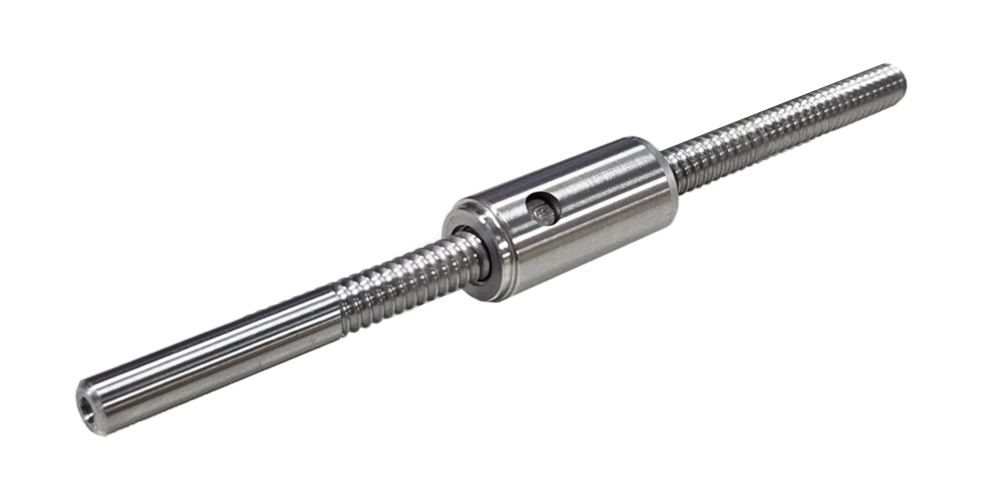
Standard ball screws are a starting point. At DINGS’ Motion USA, we engineer ball screw and nut assemblies around your exact performance, packaging, and integration requirements. Whether you need higher precision, specific end machining, or a fully integrated assembly, our team works with you to deliver a solution that fits your system without compromise.
Every application has different constraints. We tailor ball screw assemblies to match:
Screw diameter and lead configurations
Custom stroke lengths and overall screw lengths
End machining including journals, threads, keyways, and bearing seats
Nut styles including FB1, FB2, CB, KB, and MB
Preload and backlash control options
Ground (C3, C5) and rolled (C7, C10) screw options
Material and coating selections for wear and corrosion resistance
Integrated assemblies including motor, coupling, and support components



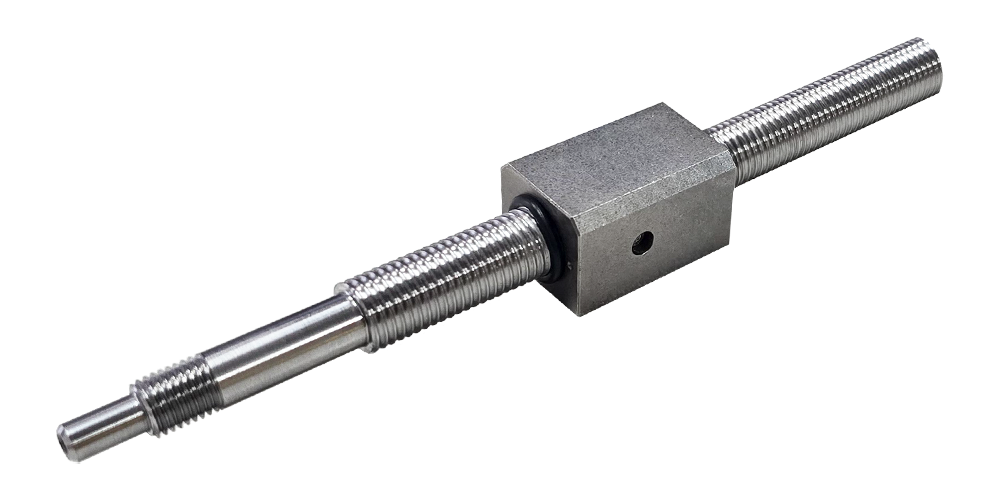
Ball Screw Dimensions Table
DINGS’ Motion USA offers precision ball screw assemblies in diameters ranging from 4 mm to 25 mm, supporting a wide range of compact to higher-load linear motion applications. Available in both ground (C3, C5) and rolled (C7, C10) accuracy grades, these assemblies provide flexible options for balancing precision, performance, and cost.
Engineers can select from multiple lead options, custom lengths, and shaft end configurations to meet specific speed, load, and positioning requirements. A variety of nut styles and recirculation methods are available, including internal and deflector designs, enabling compact integration, smooth ball return, and stable motion across varying duty cycles.
Note - Scroll horizontally to view full table on mobile
| Nominal Outer Diameter |
Lead / Lead Code |
Ground Standard Stock Length (C3/C5) See Note 1 for Notation |
Rolled Standard Stock Length (C7/C10) |
Basic Dynamic Load Ca (N) Applicable nut type shown with load value |
Basic Static Load Coa (N) Applicable nut type shown with load value |
|---|---|---|---|---|---|
| 4 mm | 1 mm / 0401 |
55R80
65R80
72R90
100R120
|
400mm |
FB2: 560
CB: 560
MB: 560
|
FB2: 790
CB: 790
MB: 790
|
| 2 mm / 0402 |
35R60
50R70
95R120
|
400mm |
FB2: 420
|
FB2: 570
|
|
| 6 mm | 1 mm / 0601 |
50R80
70R100
90R120
110R140
150R180
|
400mm |
FB2: 680
CB: 680
MB: 680
KB: 680
|
FB2: 1200
CB: 1200
MB: 1200
KB: 1200
|
| 2 mm / 0602 |
90R120
130R160
150R180
|
400mm |
FB2: 880
MB: 880
|
FB2: 1500
MB: 1500
|
|
| 6 mm / 0606 |
50R80
70R100
120R150
130R160
160R190
220R250
|
400mm |
FB2: 870
FB1: 870
|
FB2: 1450
FB1: 1450
|
|
| 10 mm / 0610 |
160R190
|
400mm |
FB2: 870
FB1: 950
|
FB2: 1450
FB1: 1600
|
|
| 8 mm | 1 mm / 0801 |
90R120
93R140
130R160
210R240
|
600mm |
FB2: 780
KB: 780
|
FB2: 1650
KB: 1650
|
| 2 mm / 0802 |
90R120
130R160
140R170
210R240
270R305
|
600mm |
FB2: 1300
MB: 1300
|
FB2: 2300
MB: 2300
|
|
| 5 mm / 0805 |
90R120
110R140
140R170
170R200
210R240
400R450
|
600mm |
FB2: 1850
|
FB2: 3000
|
|
| 8 mm / 0808 |
90R120
140R170
160R190
217R247
260R305
315R345
|
600mm |
FB2: 1450
FB1: 2200
|
FB2: 3000
FB1: 3800
|
|
| 10 mm / 0810 |
140R170
200R240
200R300
210R240
275R305
320R350
|
600mm |
FB2: 1450
FB1: 2200
|
FB2: 3000
FB1: 3900
|
|
| 12 mm / 0812 |
100R130
160R190
|
600mm |
FB1: 2200
|
FB1: 4000
|
|
| 10 mm | 2 mm / 1002 |
110R130
110R140
210R240
|
600mm |
FB2: 1450
MB: 1500
|
FB2: 3000
MB: 2900
|
| 12 mm | 2 mm / 1202 |
140R180
150R180
190R220
|
600mm |
FB2: 1600
|
FB2: 3700
|
| 5 mm / 1205 |
140R180
150R180
190R220
300R350
|
600mm |
FB2: 1600
FB1: 4100
|
FB2: 3700
FB1: 7400
|
|
Notes:
1. Effective stroke / screw length notation: Ex. 55R80 indicates an effective stroke of 55mm and a total screw length of 80 mm.
2. Acronym reference: FB1 = Flanged Single Nut Type 1, FB2 = Flanged Single Nut Type 2, CB = Cylindrical Single Nut, KB = Square Single Nut, MB = Metric Thread Single Nut.
3. Left-Hand thread option available on all C5 grade screws.
4. For rolled C7 ball screws, the shaft-end diameter must not exceed the root diameter of the screw.
5. For lengths exceeding the maximum production limit, please contact our sales engineers.
6. Dynamic and static load ratings are shown by nut type because load capacity varies by nut style for a given screw diameter and lead.
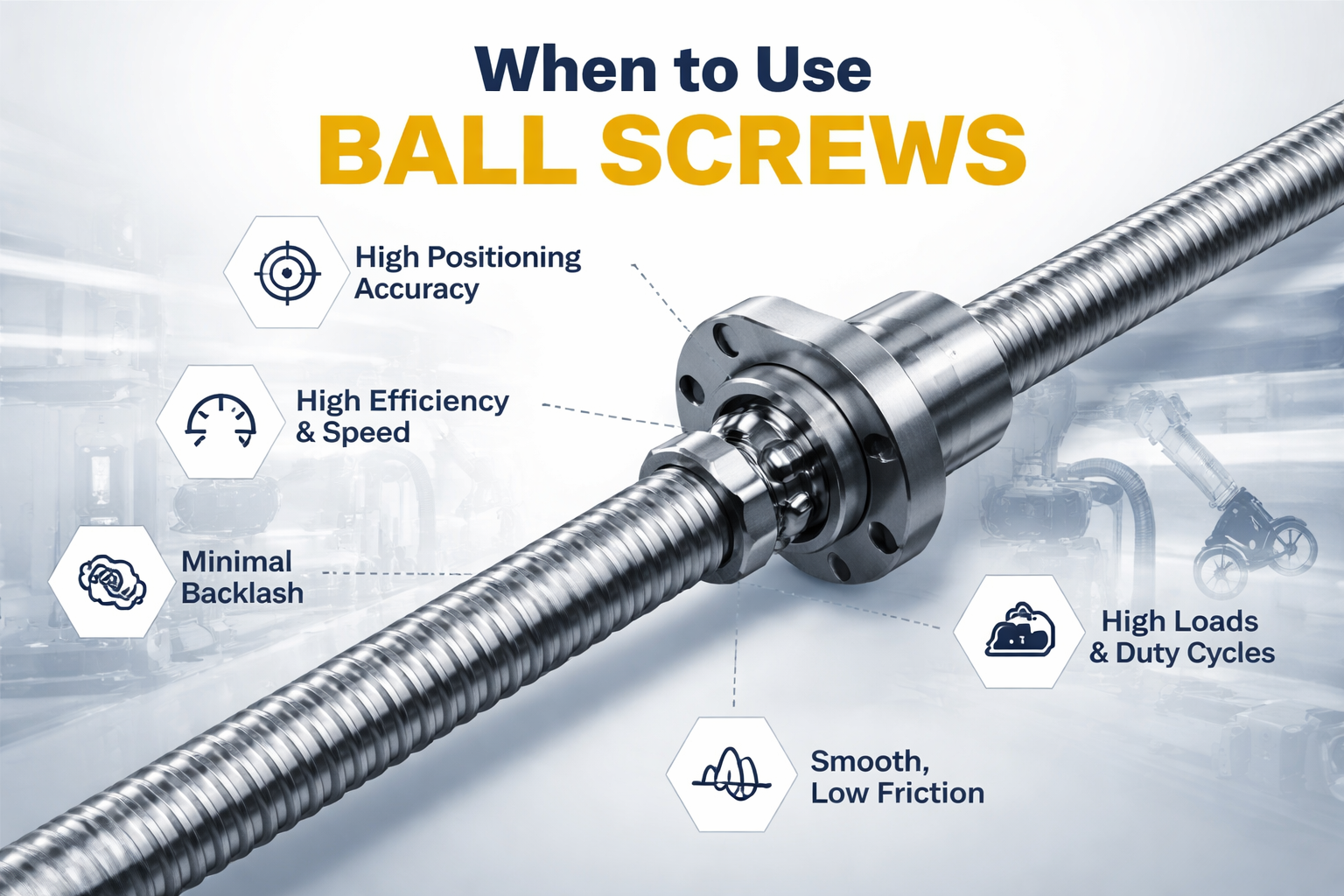
Ball screws are a strong fit when:
High positioning accuracy is required. Applications that depend on precise, repeatable motion benefit from the reduced backlash and improved lead accuracy that ball screws provide.
Efficiency and speed are critical. With rolling contact between the screw and nut, ball screws offer significantly higher mechanical efficiency than sliding lead screw systems, enabling higher speeds with less input torque.
Backlash must be minimized or eliminated. Preload options allow ball screws to operate with little to no axial play, improving system stiffness and overall motion control.
Higher loads or duty cycles are involved. Ball screws are well-suited for applications that require continuous operation, higher thrust, or extended service life under demanding conditions.
Smooth, low-friction motion is important. The rolling ball mechanism reduces friction and wear, resulting in quieter operation and more consistent performance over time.
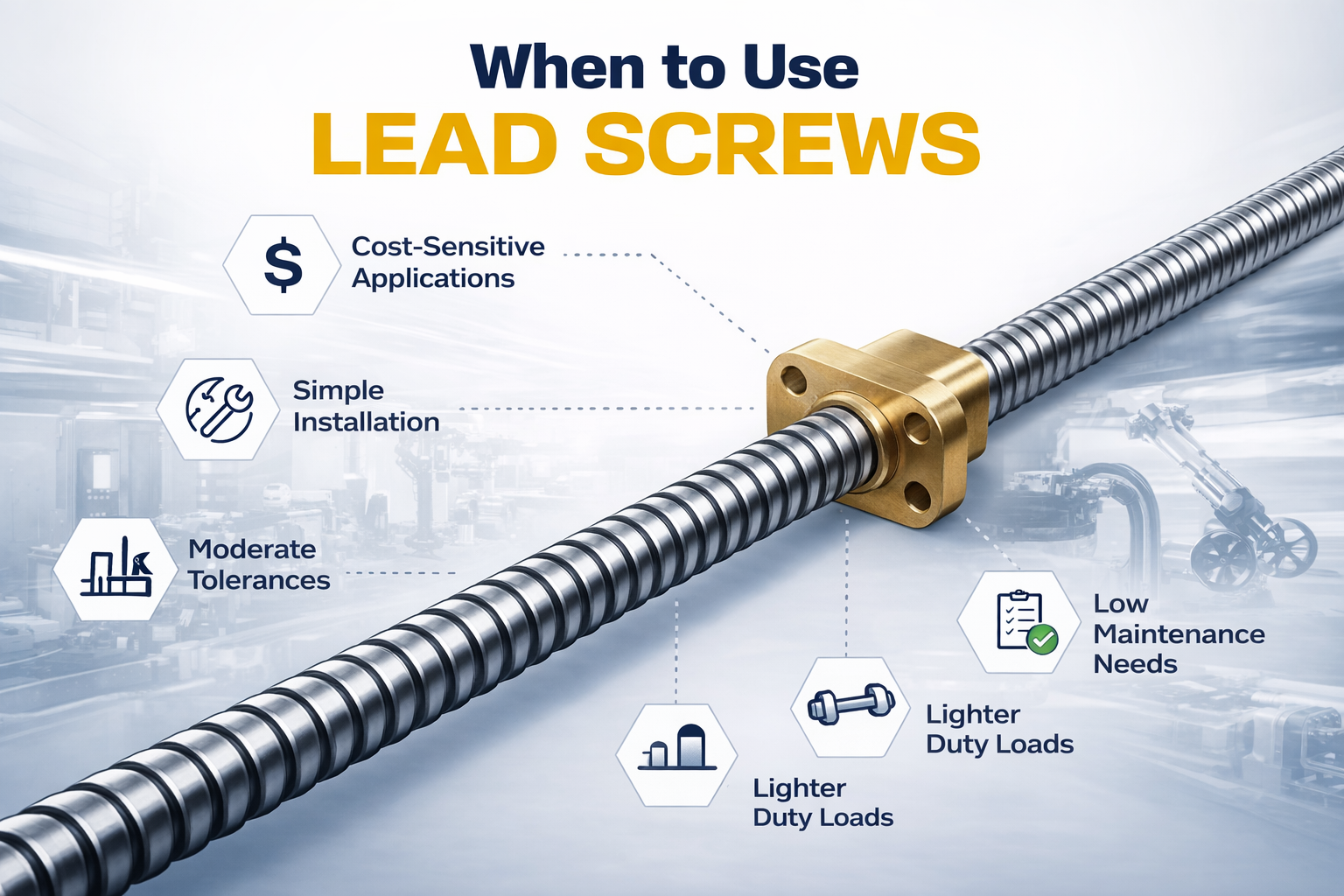
If your application prioritizes cost sensitivity or operates under lower performance requirements, a lead screw solution may still be appropriate. However, when precision, efficiency, and long-term performance are critical, ball screws are often the better choice.
When to Use Ball Screws
Ball screws are typically selected when application requirements extend beyond what traditional lead screw systems can efficiently support. While lead screws remain a cost-effective solution for many applications, ball screws are better suited for systems that demand higher performance, tighter control, and long-term reliability.