Lead Screw and Nut Assemblies
WELCOME TO DINGS’ MOTION USA
DINGS' Motion offers an extensive range of lead screw and nut assemblies.
With more than 60 lead screw diameter/lead combinations, diverse lead screw coating choices, an array of nut styles and materials, and the flexibility to customize nut dimensions, our options are virtually boundless.
If you require guidance in choosing the appropriate screw or nut, please feel free to reach out to us for assistance.
Nut Assemblies
We offer standard and custom nuts with various materials options: POM, PBT, PPS, PA66, and Bronze.
These are available in free wheeling options as well as multiple anti-backlash options (torsion and compression).
-

CS Circular Flange Free-Wheeling Nut
For 3.5mm - 15.8mm DIA Screws
-

CTS Circular Flange Free-Wheeling Nut
For 6mm - 10mm DIA Screws
-
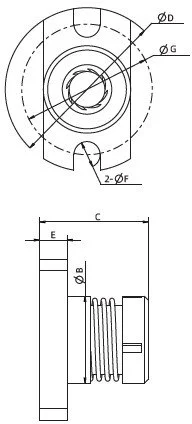
CTA Circular Flange Trimming Torsion Spring Anti-Backlash Nut
For 3.5mm - 4.7mm DIA Screws
-
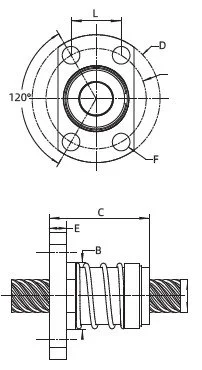
CTC Circular Flange Trimming Compression Spring Anti-Backlash Nut
For 3.5mm - 4.77mm DIA Screws
-

TTA Triangle Flange Torsion Spring Anti-Backlash Nut
For 3.5mm - 4.7mm DIA Screws
-

TC Triangle Flange Compression Spring Anti-Backlash Nut
For 6mm - 10mm DIA Screws
-

TTB Triangle Flange Torsion Spring Anti-Backlash Nut
For 6mm - 10mm DIA Screws
Lead Screw Options
Our lead screw below are Cold Rolled 303 Stainless Steel, manufactured in various diameters and leads.
Coating and end machining options available upon request.


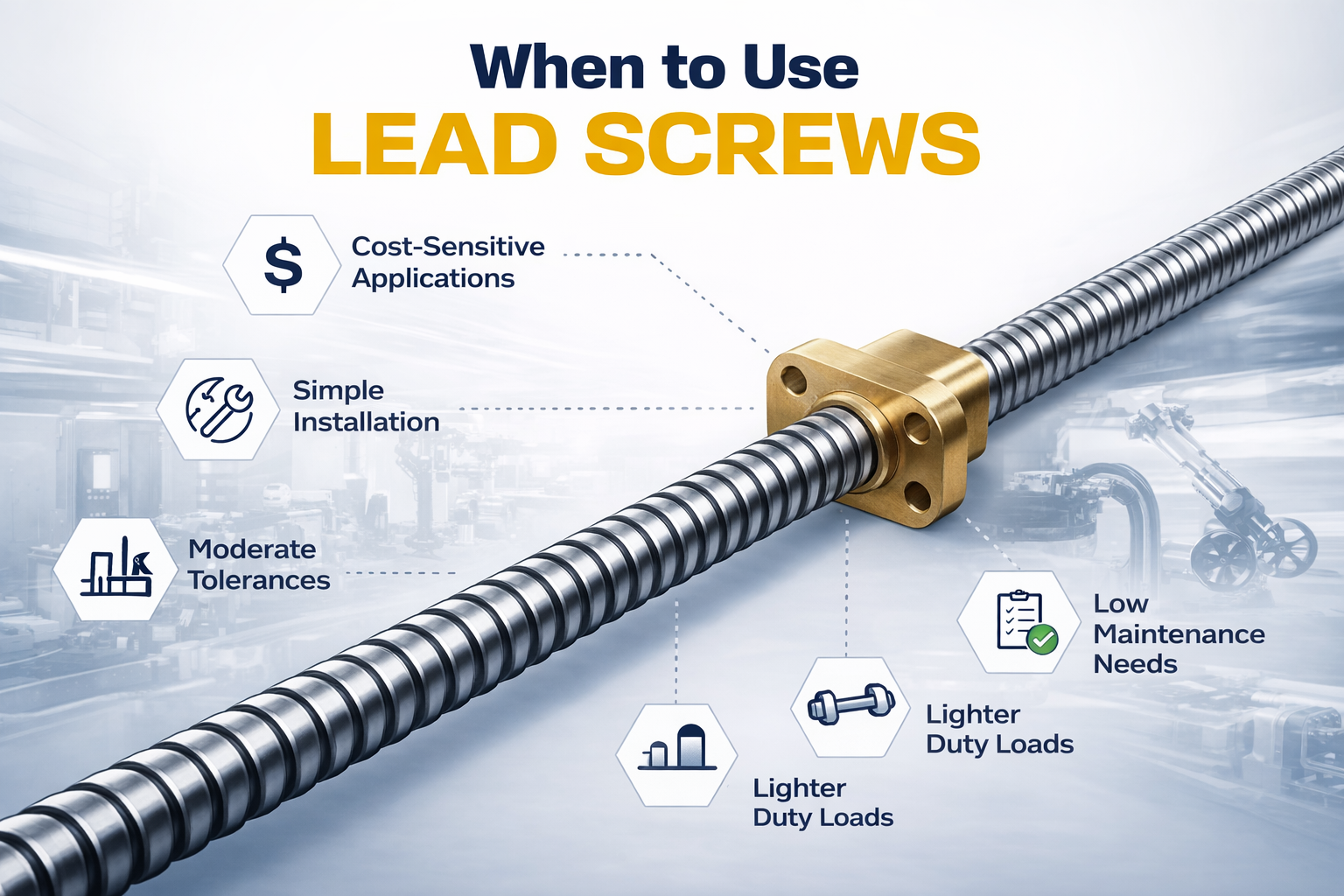
When to Use Lead Screws
Lead screws are often the preferred solution when application requirements prioritize simplicity, cost efficiency, and controlled motion over maximum efficiency or speed. While ball screws are designed for high-performance systems, lead screws remain a highly effective choice for many applications where precision and reliability are needed without added complexity.
Lead screws are a strong fit when:
Cost efficiency is a priority. Lead screws provide a lower-cost solution compared to ball screws, making them ideal for applications where budget constraints are a key factor.
Self-locking is beneficial. Due to higher friction, many lead screw systems are inherently self-locking, allowing them to hold position without continuous power, which is useful in vertical or load-holding applications.
Lower speeds and moderate duty cycles are acceptable. Lead screws perform well in applications that do not require high speeds or continuous operation, helping reduce system cost and complexity.
Quiet and simple operation is desired. With fewer components and no recirculating balls, lead screws offer quieter operation and a more straightforward design.
Maintenance needs to be minimal. Lead screw systems are generally more tolerant of contamination and require less maintenance compared to ball screws, especially in less controlled environments.
Precision requirements are moderate. While not as precise as ball screws, lead screws can still provide reliable and repeatable positioning for many applications.
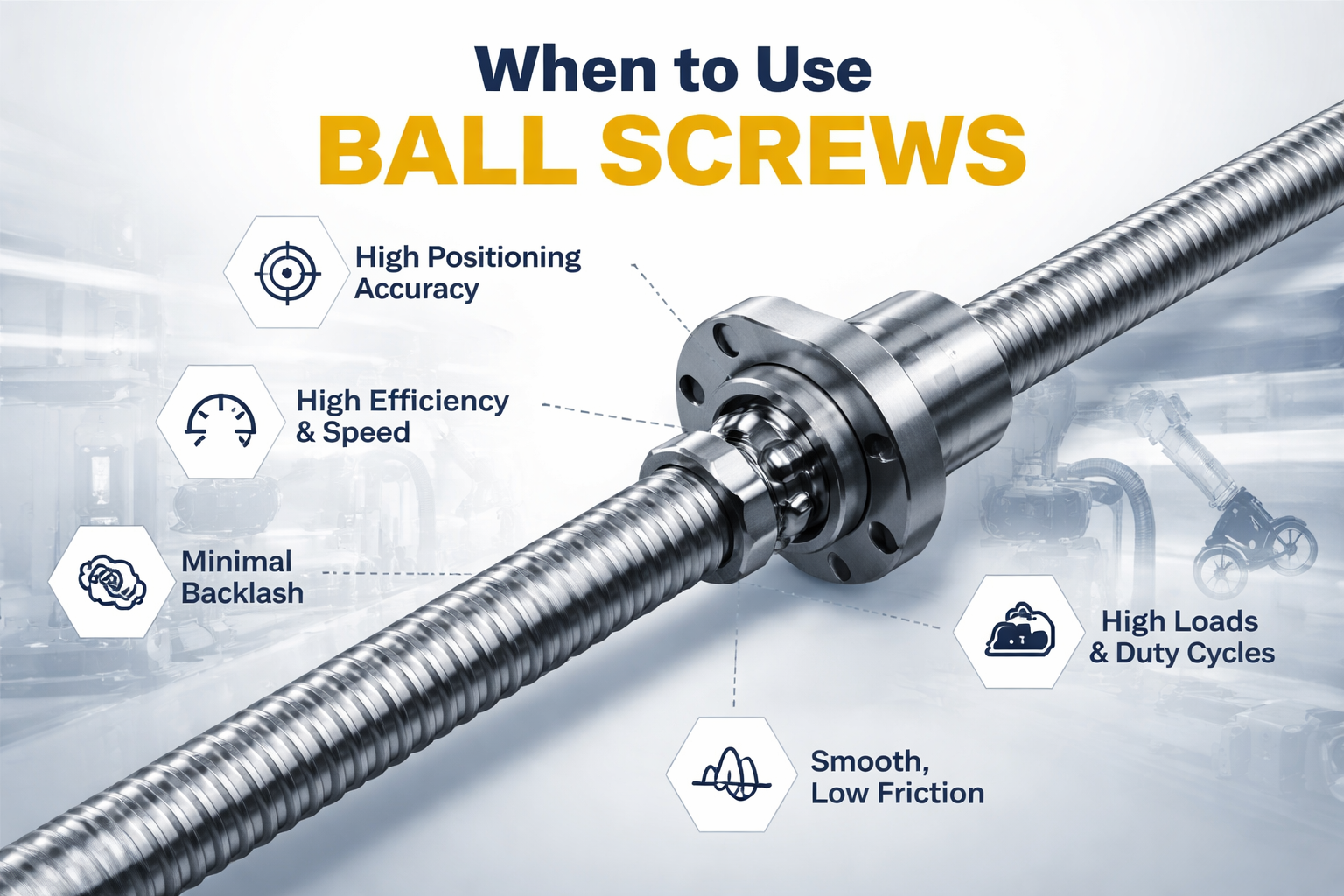
If your application demands high efficiency, faster speeds, or minimal backlash, a ball screw may be the better option. However, when cost, simplicity, and controlled motion are the priority, lead screws are often the ideal solution.